Predator control for fishery owners
In the world of fishery management, we often say that growing fish is the easy part; keeping them is where the real work begins. Whether you are running a high-end carp syndicate or a traditional day ticket fishery, predators are an ever-present tax on your stock.
Key Takeaways
- Cormorant Impact: Overwintering populations exceed 60,000 birds; effective management requires constant variation in scaring tactics.
- Mammalian Threat Profile: Otters target large specimen fish, while mink are opportunistic killers that can decimate silverfish populations.
- Crayfish Control: Intensive trapping with Environment Agency (EA) authorisation is the only way to suppress invasive signal crayfish numbers.
- Legal Compliance: Most control measures require licensing; always consult the Angling Trust or Natural England before taking lethal action against avian predators.
Avian predators – the cormorant crisis
The cormorant is the primary antagonist for the inland fishery manager. These birds are capable of consuming a significant percentage of a lake’s biomass over a single winter. In my experience, they are most destructive when they “pack hunt,” driving fish into shallow corners where they can be easily picked off. Goosanders, while smaller, are equally problematic for river managers, as they target juvenile salmonids and dace with surgical precision.
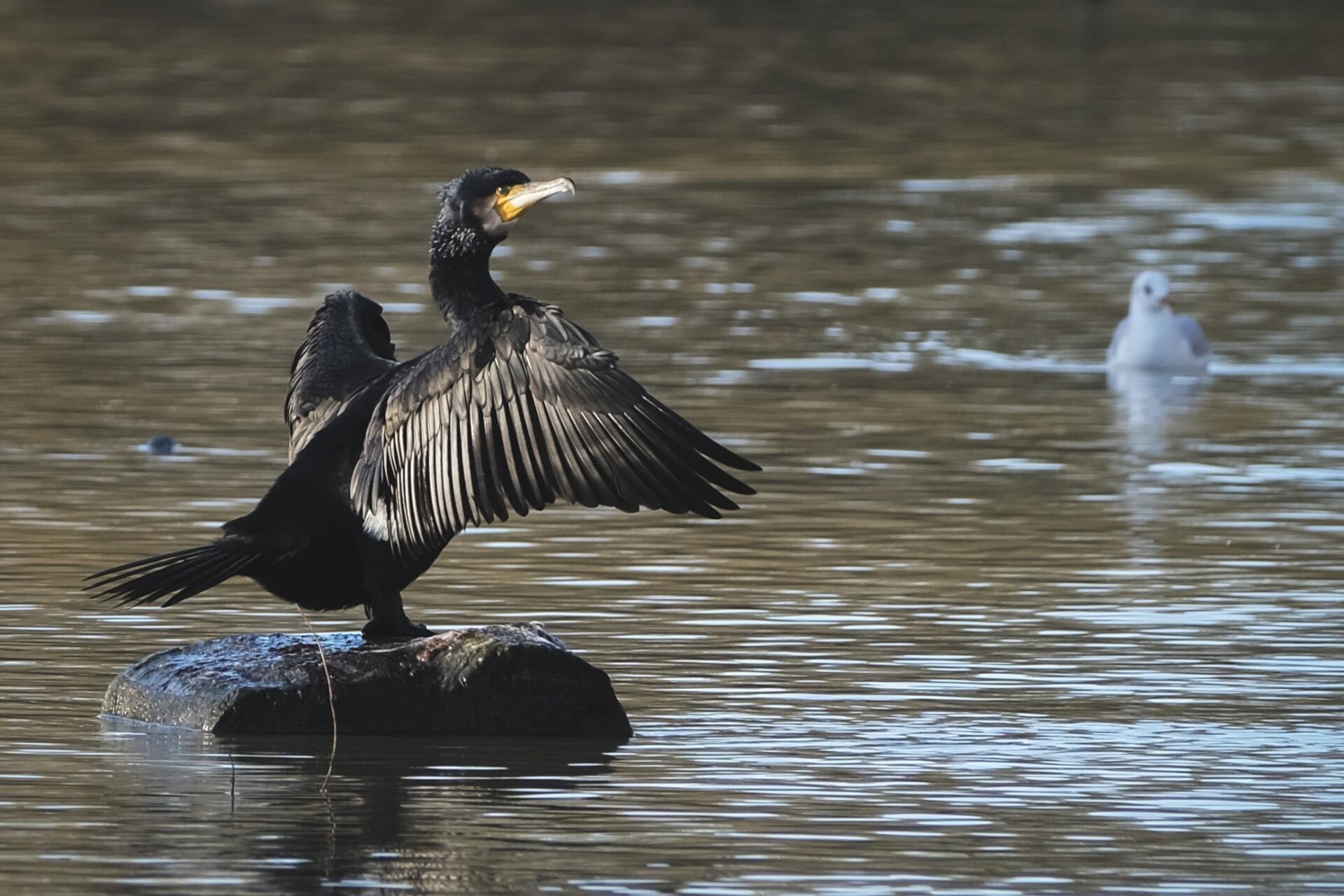
These birds are capable of consuming a significant percentage of a lake’s biomass over a single winter. © 2026 Aman Sangha
Advanced deterrent solutions
To manage these birds, you must be the presence on the bank. Human manikins, mirrors, and acoustic scarers (like gas guns) only work if they are moved or triggered unpredictably. If a cormorant sees a manikin in the same spot for three days, it will eventually sit on the manikin’s head to dry its wings.
For a more permanent fix, overhead monofilament grid lines are highly effective for smaller pools. By stringing high-visibility 30lb line across the water at 10-foot intervals, you disrupt their flight paths.
Creating “fish refuges.” can also help. These are submerged structures made from recycled materials or brushwood that provide a physical sanctuary where birds cannot dive. By changing the underwater architecture, you give your silverfish a fighting chance.
Mammalian predators: Otters and Mink
The recovery of the European Otter across the UK is a triumph for conservationists but a severe challenge for fishery managers. Unlike birds, which take smaller fish, an otter is an apex predator capable of taking down the largest residents of your lake. They often display “surplus killing” behaviour, where a single otter may kill several large fish in a night, eating only the nutrient-rich throat or liver.
Then there is the American Mink. As an invasive species, mink are smaller but arguably more aggressive hunters. They are semi-aquatic and will target everything from small carp to nesting waterfowls. Identifying the difference is key: otter spraints (poo) are larger than minks, with a diameter of around 2cm. They can be of variable length, and often contain fish scales and bones. While minks are smaller and their presence is often marked by the wholesale disappearance of smaller stock or bankside wildlife.

Otters often display “surplus killing” behaviour, where a single otter may kill several large fish in a night
The solution – Physical Exclusion
Once an otter has identified your fishery as a food source, it will return nightly. Scaring tactics do not work on these intelligent mammals. The only proven, 100% effective solution for stillwaters is the installation of specialised fencing.
A company, such as Otterstop uses high-tensile steel mesh that is specifically engineered to withstand the strength of an otter. A standard fence is useless; an otter will simply climb over it or squeeze through gaps. Otterstop fences are designed with a specific height (usually 1.2m) and a “cranked” top that leans outward at a 45-degree angle, making it physically impossible for an otter to scale.
Furthermore, the “skirt” is the most critical component. Because otters are prolific diggers, the Otter and mink fencing involves burying the mesh 300mm into the ground or pinning a horizontal mesh skirt to the turf. This ensures that even if a predator tries to tunnel under, they hit a steel barrier.

A company, such as Otterstop uses high-tensile steel mesh that is specifically engineered to withstand the strength of an otter.
Signal Crayfish – the underwater locusts
Signal crayfish decimate the bottom of the food chain by eating fish eggs, predating on small fish, and destroying bankside habitat through burrowing. While eradication is almost impossible in open systems, population suppression is vital.
Shown in the photo on the left, the invasive Signal crayfish (Pacifastacus leniusculus) is significantly larger and more aggressive than the native species, characterised by a smooth, reddish-brown carapace and a distinctive white-to-turquoise “signal” patch at the claw hinge, with bright red undersides on its robust claws.
In contrast, shown on the right, the protected UK native White-clawed crayfish (Austropotamobius pallipes) is much smaller with a rougher, olive-green to brown body and narrower claws that feature a pale, off-white or pinkish underside. Beyond physical differences, the Signal crayfish poses a severe ecological threat by outcompeting the native species for food and habitat while carrying “crayfish plague,” a water-borne mold to which the native White-clawed crayfish has no natural resistance.
The solution
Management requires a persistent, high-intensity trapping program. However, you must first obtain an “Authorisation to trap crayfish” from the Environment Agency. To protect native wildlife, you must use “otter-friendly” traps. These are designed with specific mesh sizes and entrance holes (no larger than 95mm) to prevent otters or water voles from entering and drowning.

The invasive Signal crayfish (on the left) is significantly larger and more aggressive than the native species (on right)
Zander – the aggressive immigrant
Zander are considered a significant threat to UK aquatic ecosystems because they are highly efficient, non-native predators that can severely disrupt the natural balance of fish populations, particularly in narrow or turbid waterways like canals. Unlike the native pike, which often waits in ambush, Zander are active pack hunters with specialised “cat-like” vision that allows them to thrive in murky waters where native silver fish, such as roach, gudgeon, and skimmer bream, are most vulnerable.
Their presence has been linked to dramatic “crashes” in prey fish biomass, and they compete directly for resources with native predators like perch and pike. Due to this ecological risk, Zander are legally classified as an invasive species under the Wildlife and Countryside Act 1981, meaning it is currently illegal for an angler to return a captured Zander to the water; they must be humanely dispatched to prevent further spread and damage to the UK’s native biodiversity.
The Solution
Under the Keeping and Introduction of Fish Regulations 2015, Zander are classified as a non-native species in many areas. In most canal systems, they cannot be returned to the water once caught. Fishery managers should encourage “predator culls” or specific match events aimed at removing Zander. Working in partnership with the Canal & River Trust is essential for sanctioned removal programs.

Zander are considered a significant threat to the UK
FAQ: Protecting Your Fishery
Q: Can I shoot cormorants if they are eating my stock? A: Only if you hold a license from Natural England. You must prove you have tried non-lethal methods first, such as manikins or acoustic deterrents.
Q: Does otter fencing need to be electrified? A: It is not strictly necessary with a cranked-top fence, but adding two offset electric wires provides an extra layer of psychological deterrent that prevents the otter from even touching the mesh.
Q: Is a mink trap legal? A: Yes. American Mink are invasive. You can trap them and dispatch them humanely on-site. You must never release a trapped mink back into the wild.
Q: Do “fish refuges” actually work? A: Absolutely. Research shows that providing tight, complex structures in the water allows fish to escape the direct line of sight and pursuit of diving birds.
Q: Can I get a grant for fencing my lake? A: Yes, the Angling Trust often manages the “Angling Improvement Fund,” which can provide grants for predation protection projects.
Q: How do I legally trap Signal Crayfish? A: You must apply for a permit from the Environment Agency. It is illegal to trap them without this, and you must use approved traps that prevent non-target species from being harmed.
Q: What should I do if an angler catches a Zander at my venue? A: According to current legislation for “online” waters, the fish should not be returned. It is best to have a club policy in place that aligns with Canal & River Trust guidelines for humane removal.
Q: What is the most effective way to stop herons? A: Use “heron string” (a low-tension wire) placed 15cm above the ground around the water’s edge. Herons prefer to walk into the water; the wire trips them and discourages them.
Evidence of experience & verification
This article was compiled using current 2026 guidelines from the Angling Trust, Canal & River Trust and the Environment Agency.
Sourcing & Official Regulations
- Environment Agency
- Natural England: Wildlife Licensing
- Angling Trust: Predation Resources
- Canal & River Trust: Invasive Species Policy

Similar articles

A guide to adding accommodation for fisheries
How to increase the income of your fishery by adding accommodation for anglers in the form of lodges, huts, cabins, pods and other modular buildings to your fishery venue.
Fisheries improvement programme opens for applications on 1st December
Angling clubs and fisheries will soon have the opportunity to secure funding for local development projects as the Fisheries Improvement Programme (FIP) opens for applications on Monday 1st December.
How to install foundations at your fishery
We delve into the challenges of waterside construction, outlining the advantages and disadvantages of various foundation types, and learn how to create durable, long-lasting structures that add value to your fishery.
The latest angling pods hit the fisheries market
Join the growing number of fisheries which are boosting their income by installing Tardis Angling Pods – providing their customers with comfort and convenience while adding real profit to the bottom line.
How to choose the right type of boat for your fishery
Whether you are a fishery owner looking for a boat to maintain your lakes or wanting a fleet of boats to let your own anglers get out on the water, choosing the right type of boat for the job can…
How lake fertilisation can improve your fishery and fish
Resident fishery management expert Bruno Broughton explores how lake fertilisation can help improve your fishery and explains how to go about it.
Make more money from your fishery!
Our ‘Top 10 Tips’ on how to make more money from your fishery this year. Not all are easy and most require some investment – but they will definitely help to increase the revenue from your fishery
Timely advice on coarse fish stocking
Fisheries Management Consultant, Dr Bruno Broughton, gives timely advice on when and how to stock new fish.
Turn day ticket anglers into loyal customers – Guide for 2025
How many of your day ticket sales will turn into repeat customers in 2025? We’ve come up with 7 ideas that will help you turn new anglers into loyal returning customers.Search by Region or County
Find new places to go fishing in your local area or county by choosing your destination below





Comments