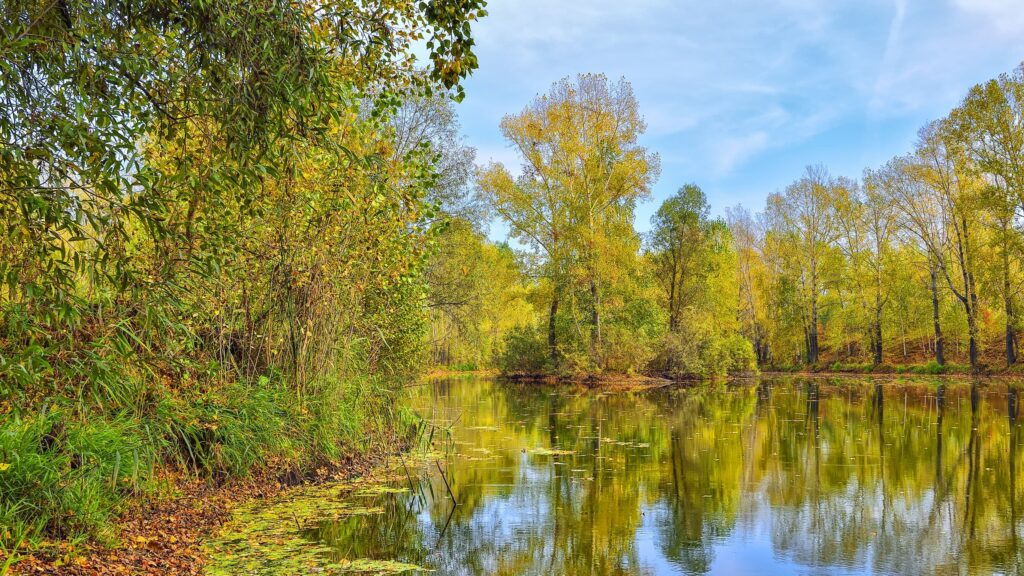
Coombe Abbey Park Fishery
Part of the Coombe Abbey Park to the north of Coventry at Binley, Coombe Pool Fishery offers estate lake fishing at a low price and has a reputation for producing big fish including specimen carp, tench, crucian carp, bream, pike and zander.
Coombe Abbey Park Fishery facts and features
Coombe Abbey Park on the outskirts of the city of Coventry has been a popular leisure attraction for many years and is now nationally recognised as a Green Flag award winning site. Once acclaimed as one of the country’s leading big bream match waters, Coombe Pool now concentrates on providing pleasure and specimen angling for day ticket and season ticket anglers on what is still one of the UK’s most stunning specimen fisheries with bream to 10lbs and double figure zander to 16lbs regularly being banked. Pleasure anglers often enjoy impressive bags of bream weighing in at over 100lbs.
Dating back from 1580
The buildings which can be seen today were constructed between the 1580s and 1774 whilst the parklands, landscaped by Capability Brown, form part of the extensive 500-acre country park where visitors can enjoy the breathtaking view and wildlife throughout the year. Most of Coombe Abbey Park is designated as a Site of Special Scientific Interest (SSSI) because it is one of the most important ornithological sites in Warwickshire. As a result, angling has to go hand-in-hand with nature conservation.
For this reason, only half of the lake furthest from the hotel is reserved for angling. However, when you consider Coombe Pool is the second largest expanse of stillwater in Warwickshire after Draycote Reservoir, this still gives anglers more than enough to go at. The fishery also observes the traditional closed season, closing for angling from March 14 to June 16.
Where to fish at Coombe Abbey Park
Angling on the lake is from three banks. The two public banks, known as the Damwall and Woodland, are open all season and offer 47 pegs. The Lindley bank is situated in the West Deer Park and is accessible only to season ticket holders or pre-booked matches. This bank consists of 26 pegs and is open until the end of December.
Coombe has a history of being a challenging water but one where in the correct conditions large numbers of fish can be caught. As a result, Coombe Pool is attracting growing numbers of discerning anglers, particularly specialist and pleasure specialists interested in the big carp, tench, bream, pike and zander.
As part of the continuous programme of fisheries enhancement, work is continuing on the development of the lake edge for fish refuge and artificial reefs have been created at various sites. Using gabions – metal wire mesh cages used for erosion stabilisation – tyres and wooden structures called kackabunds, the reefs now provide shelter for young fish and invertebrates and provide anglers with additional features to fish to. Coloured buoys have been placed on the artificial reefs to prevent anglers from becoming snagged in them.
A great value days fishing
The emphasis of the fisheries management policy is to provide traditional estate lake angling at an exceptionally low price. As a result, Coombe Pool is an accessible, very cheap, beautiful and productive fishery to visit and although the fishing isn’t always easy it is a venue well worth visiting and a delightful spot to fish.
Another feature of Coombe is that it has a policy of responding quickly to anglers’ queries about how the lake is fishing. For queries or information on how the lake is fishing anglers should contact Jake Davoile, one of the Angling Trusts’s Fisheries Management Advisers on 07949 703206. All told, it is a credit to Coventry City Council that it makes a first-class water like Coombe Pool available at low cost to day ticket anglers, whilst season tickets are available for those who want to fish the water more frequently or visit for longer stays.
Bream fishing at Coombe Abbey
Bream fishing at Coombe Pool
Coombe Pool has a large population of bream, usually between 6lbs and 11lbs. These fish are commonly found in a few large shoals which can provide anglers with great fishing if they can hold the shoal in their swim with copious amount of bait. Locating these shoals is the angler’s first challenge and they should keep their eyes open for large areas of coloured water which is often caused when a shoal has been stirring up the bottom for food. Another common activity is rolling or ‘head and shouldering’. This behaviour, which is more common at dawn and dusk, is associated with feeding in many species and will give away the presence of fish. Because the water is shallow at Coombe – generally only about four feet deep – the larger fish may also give their position away when feeding by having their backs or tails exposed.
Fishing for bream at Coombe can be extremely good, with bags of fish caught regularly to nearly 100lbs in weight, and occasionally to 200lbs when anglers get it right. However, because of the size of the water, location of the shoals can be very difficult. The key to success at Coombe is firstly to locate the fish and then to feed them. There are no favoured ‘bream pegs’ as the shoals move around the lake depending on conditions. Try and fish a windward bank, or anywhere where the water is coloured and stirred up. Once a shoal is located, it is important to have enough bait to hold the hungry shoal in your swim for as long as possible. If the food source runs out it is likely that the fish will move on.
Bait recommendations for Bream
Groundbait is usually used with lots of squats, pinkies, maggots, casters, hemp, sweetcorn, chopped worm and such like. By using lots of food particles, the bream shoal will stay in the swim for longer as they search through the silt for food. During winter the fish will shoal more densely and location becomes more difficult. Smaller bream and hybrids often migrate towards the Smite Brooke in late winter and can regularly be seen from the footpath.
A lot of the smaller bream caught in the fishery are usually roach/bream hybrids, although silver bream have also been caught. True silver bream are considered quite rare in England as much of their true genetics have been contaminated by cross hybridisation. At Coombe Pool, several of the large breeding silver bream were used by the Environment Agency to successfully artificially spawn this species for the first time and thus allow stocking in other waters. Due to the rarity of the fish, Coombe Pool is one of the few waters in England that gives the angler a realistic chance of catching a true specimen.
Feeder fishing
Fishing is often done at long range, usually by swimfeeder using either a swing-tip, quiver-tip or bite alarm. The rigs are simple – a 3lb main line with the feeder on either a four-turn water knot or a standard loop set-up. Experiment with the length of the tail, although three to five feet is standard. Accurate casting is also a must at Coombe. Casting can be made easier by incorporating a stop knot on your line for reference or alternatively using the bait clip on the reel as a casting stop – although heavy lines are required for this approach.
Feeding at this range can be tricky and several anglers use either bait boats or bait scoops to get large quantities of groundbait out to the hookbait. Hookbaits can be anything contained in the ground bait mix, though it is usual to use small red worms or maggots.
Care should be taken when using keepnets for big bags of bream, two or more nets should be used for large catches. Also because the lake is quite shallow, care must be taken in the positioning of keepnets. As a rule, try and position keepnets in deep water that is well shaded to avoid stress to the fish and use unhooking mats for specimens or larger fish, especially on the hard ground of the dam wall. Popular pegs are on the Dam Wall bank are numbers 1 to 7 and on the Woodland bank numbers 1 to 25. However, anglers are advised that fishing the Woodland bank involves a fairly long walk. Whichever bank you choose, they all respond to the same methods.
Zander fishing and Coombe Abbey
Fishing for zander or pike is only allowed after October 1st. Specimen zander and pike hunters have been targeting Coombe for many years, but have been really reaping the rewards in recent seasons. Zander, illegally introduced into Coombe around the mid 70’s, have grown at a tremendous rate and the biggest to come out so far weighed more than 19lbs! In recent years several other fish in the 16lb range have been caught, although the average size is generally around 8lbs with fish to over 10lbs regularly being taken. This makes Coombe Pool the place to go for a realistic chance of catching a truly massive zander.
NIght fishing for Zander
However, to be successful for zander you normally have to fish at night, which requires a Full Season Ticket. Small freshwater fish baits are commonly used, both live and dead. With regard to rigs, most zander caught at Coombe are taken on simple running rigs. The secret is to minimise resistance to the fish as they are a very shy-biting species and often drop the bait if they feel the resistance of a heavy lead and line.
The majority of zander are caught on the Woodland Bank pegs 1 to 44, often at very long range with baits usually being dropped off by bait boat. The lake can be quite shallow and featureless, so the fish can be anywhere, although bank-side overhanging trees are a common fishing feature. The fishing is usually better when the water is coloured with the majority of fish coming out during the early winter months.
Pike to over 25lb have been caught
Pike are also one of the main species, along with zander, that attract anglers to Coombe Pool. There are several big fish in the lake with a few running to over 25lbs in weight. However, there are also numerous smaller fish, the average size being around 8lb, which gives the angler a good chance of catching whatever the weather conditions with the added bonus of a chance of a really big pike.
What is the largest pike to come out of Coombe? Well, several 20lb to 26lb fish come out each year and as one well-known pike angler once said, “If Coombe can produce zander to nearly 20lbs, think how big the pike could go!” Pike angling starts in earnest in October, with many bream and carp anglers turning their attention to the species. The first few weeks in October tend to be the most productive. However, pike don’t like pressure and often after the initial success of the early winter, the pike migrate up the lake or become a lot harder to catch.
Favourite swims are the first few pegs near the reedbed and the last few pegs on the dam wall. Small fish are often herded by the pike and zander into this area in the winter, and if the small fish are there, the pike and zander are often there as well. The pike in Coombe tend to be very nomadic, maybe due to the featureless lake bed, therefore, when fishing, a roving approach is advisable, swim hopping until the fish are found.
Make sure you have the correct gear for Pike
Obviously before fishing for pike, anglers should be aware of how to properly hold and unhook the species. Fishery Officer Jake Davoile is always on hand to help out and give advice when required. Anglers should also have the correct fishing gear for the species, especially a minimum of a 42″ landing net, a long unhooking mat, a pair of forceps and a pair of wire cutters. When pike fishing it is vitally important to use a wire trace as this stops the pike’s teeth from cutting through the line. The trace should be a minimum of 18in long and made of 20lb wire.
Most baits will catch pike from Coombe with spinners and plugs working well because the water is relatively shallow. Dead baits also often work well with large pieces of smelly fish like mackerel or sardines taking a large number of the bigger pike. As the water is large, it is important to attract the fish to your swim. Some anglers do this by ‘glugging’ or injecting their baits with various types of fish oil or amino acid dips before casting out. Float fishing for the predators is rarely used as most anglers, when using dead baits, use running ledger rigs with light leads on the lead link, allowing it to rest in the silt and not pull the bait in to it.
Carp and coarse fishing at Coombe Abbey
When it comes to carp, Coombe carp can be difficult to catch. However, because the stocking rate is relatively low at about 150 fish, most are large with the majority weighing over 20lbs with mirrors to 34lbs and commons to 39lbs being caught. Because of the low density rate, few anglers actively fish for carp at Coombe and the fish that are caught each year tends to come to the same few season ticket holders. Most of the carp are caught at night, due to the clarity of the water, with the majority coming to large beds of bait over a period of nights. Stalking is also a successful method, especially around the beds of lily pads on the dam wall
Recommendations for bait
Beds of hemp seed, chopped boilies, particles and trout pellets all help to stop the nomadic carp in their tracks. Due to the silty nature of many areas, pop-ups that are critically balanced should be used. If your bait comes back smelling of silt this is a good indication that you are fishing in the wrong area.
By careful plumbing and leading around, hard areas of clay can be found and these are the spots to fish. In the summer a large proportion of the lake is covered in lily beds and obviously, these are often good areas to fish to or to fish on in the winter when they have died back. Hookbaits should be large – over 25mm – to avoid the bream and tench.
Commons to 35lb
As part of the pool’s management plan, stocking small numbers of quality carp continues. The largest of the commons stocked a few years ago recently came out at 35lbs! Furthermore, the most recent fish are doing well with one known to have put on 10lbs in two years. These are the future big fish of the pool. Although stocking levels have been increased, the aim has been to provide challenging traditional estate lake carp fishing at a reasonable cost.
Tench to 9lb at Coombe Abbey
The tench fishing at Coombe has been fantastic over the past few seasons with fish to 9lbs being caught in superb condition.
Look no further than the lily pads early in the season for the larger specimens which can be caught close in on the float or further out in open water on the feeder.
There are also other species in Coombe that seem to get overlooked. There are huge shoals of roach and rudd inhabit the lake. These can be caught fishing the waggler with hemp, casters and maggots. Also, if you can find them, there are some incredible crucians to be caught with fish to 4lbs 8oz having been taken in the past.
Prices
Day tickets are to be purchased from the car park ticket machine. Failure to do so will result in a £10.00 bank fine. Anglers should note that the machine does not give change. Season tickets can be purchased from the Visitor Centre within the main Country Park from May 1. Anglers will need two passport photographs and their current rod licence. Anglers should note that fishing for zander or pike is not allowed until October 1.
Day Tickets |
Adults | GoCV+ | Juniors | Day ticket (dawn to dusk) |
|---|---|---|---|
|
|
|||
|
6.00
3.00
3.00
|
|||
| Day ticket (dawn to dusk) | 6.00 | 3.00 | 3.00 | Specimen ticket |
|
|
|||
|
8.00
4.00
-
|
|||
| Specimen ticket | 8.00 | 4.00 | - |
Season Tickets |
Adults | GoCV+ | Juniors | Full ticket |
|---|---|---|---|
|
|
|||
|
130.00
65.00
-
|
|||
| Full ticket | 130.00 | 65.00 | - | Dawn to dusk |
|
|
|||
|
65.00
30.00
-
|
|||
| Dawn to dusk | 65.00 | 30.00 | - | Dawn to dusk (mid week only) |
|
|
|||
|
50.00
25.00
-
|
|||
| Dawn to dusk (mid week only) | 50.00 | 25.00 | - |
You may also be interested in
If you like the look of this fishery then there are other fishing lakes in Warwickshire and the West Midlands that you may also like, including Hopsford Hall Fishery, Kingsbury Water Park, Oakham Farm Fishery, Riddings Fishery and Stockton Reservoir.





Comments